Turn any screen into an interactive touchless experience.
Wherever screens meet people.
Touchless OS
Our platform runs the full engagement funnel for physical spaces, and reports on it like a website. In live venue tests, a screen that responds made 2.5× more people stop and held their attention more than 5× longer – 13.5× after dark. One platform, on the screens you already own.
Dwell time by hour
Same screen, same evening. Drag to swap the passive video ad for the interactive mode.
5.1×at 7 PM: 2m55 passive vs 14m55 interactive
Total view time per hour, 4–9 PM, one street-facing screen at a live venue. Modes alternated hourly; striped bars fill an hour from its measured neighbours.
1. AttractBefore anyone touches anythingPeople stop for it
On the same screen, interactive mode made 2.5× more passers-by stop and look than a high-quality video ad.
People stop for it
On the same screen, interactive mode made 2.5× more passers-by stop and look than a high-quality video ad.
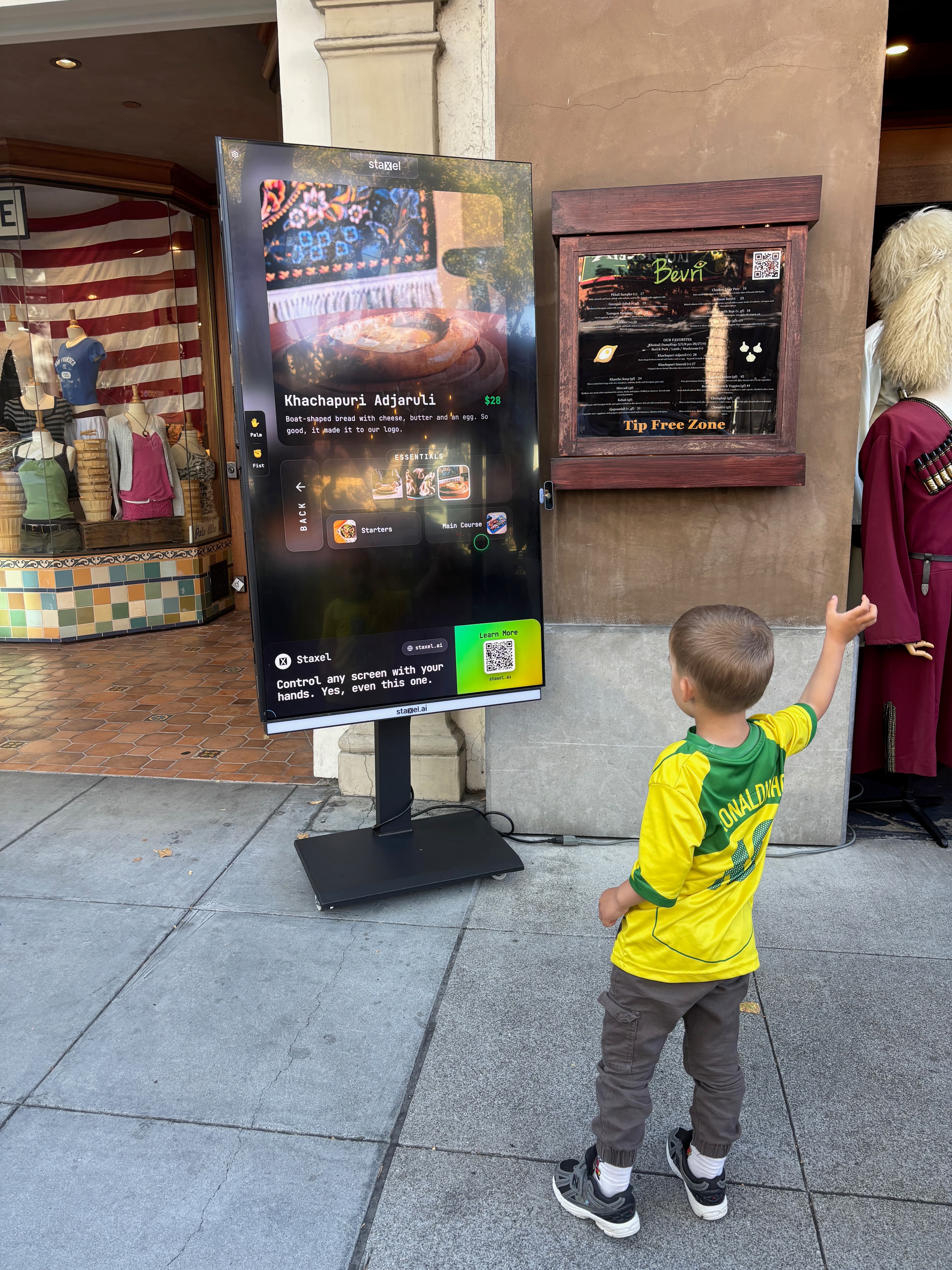
The screen sees people approach and responds – it waves, invites them over, adapts to whoever is standing there. An attract layer no static signage or touchscreen has.
Share of walk-bys who looked for longer than 2 seconds. One street-facing screen at a live venue, three consecutive days.
2. EngageOnce they stop and lookExperiences people choose, and stay with
Your content as touchless interaction, AI agents and games: more than 5× the view time of the same screen running a video ad.
Experiences people choose, and stay with
Your content as touchless interaction, AI agents and games: more than 5× the view time of the same screen running a video ad.
- Your content, aliveMenus, offers, wayfinding, speakers and product stories.
- AI agents, in the roomA brand concierge that greets, guides and answers.
- Magic BoothAI photo keepsakes themed to any event or venue in minutes.
- Play togetherGames and quizzes, multiplayer by nature.
Same screen, same location, alternating hour by hour
Total view time per hour, 4–9 PM. Hourly A/B on one screen in a single day: even hours ran the video ad, odd hours ran the interactive mode.
3. AmplifyBuilt into every experienceBuilt to share and keep
A Magic Booth in your branding – no hardware, no props, no logistics: keepsakes people share and keep.
Built to share and keep
A Magic Booth in your branding – no hardware, no props, no logistics: keepsakes people share and keep.
per screen, per week
after creating a memory
Magic Booth at one live venue over a week: 23,365 people walked past, 301 made a keepsake, 48 left an email to keep it.
4. MeasureAnalytics for the physical worldDigital-grade data, IRL
Conversion, dwell time and interaction paths by audience group, just like online. No faces stored, no identities tracked.
Digital-grade data, IRL
Conversion, dwell time and interaction paths by audience group, just like online. No faces stored, no identities tracked.
- ConversionWalk-by to stop to interaction to lead, per screen and per hour.
- Dwell timeHow long people stay, by content and by time of day.
- Interaction pathsWhat they opened, in what order, where they dropped off.
- Audience groupsAggregate group signals only – never an identity.
Every number in this funnel came out of this dashboard: 23,365 walk-bys tracked in a week at one venue.
Real-World Success Stories.
Honest answers to fair questions.
How is this better than a touchscreen?
Different question. Staxel's core idea is making ordinary passive screens interactive and data-driven. Most screens in the world will never be touchscreens: too big, too high, behind glass, or already installed. For those, the comparison is not touch vs touchless. It is interactive vs dead.
And where a touchscreen is an option?
Then it depends on the use case. Touchless wins on hygiene, long-term reliability (touch panels degrade in public spaces), cost that does not scale with screen size, and computer-vision analytics. Touch wins on speed and precision for private, close-up screens. For public displays and signage, touchless is usually the better combination.
Interactive displays have been tried before. Why now?
Earlier attempts were one-off activations: expensive hardware, custom builds, no data. Staxel is software on commodity hardware with recurring venue use cases, from menus and navigation to promos and analytics, so the screen keeps earning after the launch moment.
What do I need to run it?
Three things, all of them ordinary – and one of them you already own.
- 01Your screenTV, projector, LED wall, kiosk
- 02Mini-PC
- 03Basic webcam
Put your screen to work.
Tell us about your space, event, or idea. We'll show you what your existing screens can do.
Get in touch[less]